Self-Supervised Goal-Reaching Results in Multi-Agent Cooperation and Exploration
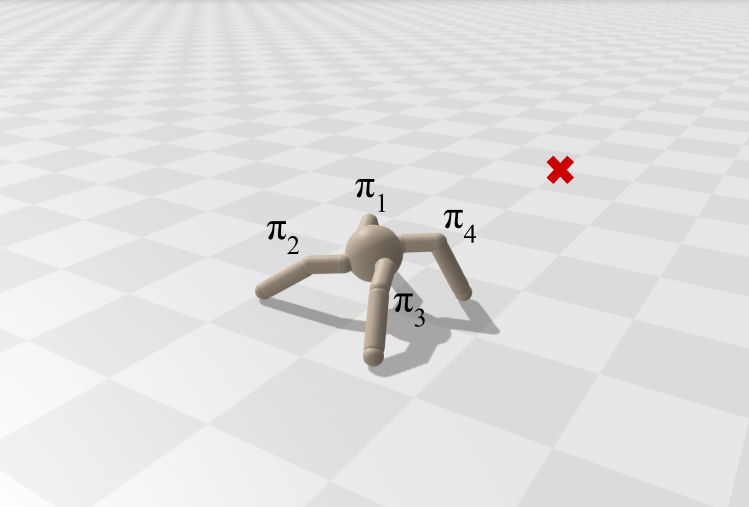
The problem. Training multiple reinforcement learning agents to work together is hard, especially since it usually requires carefully designing a task-specific reward function that encourages agents to cooperate effectively.
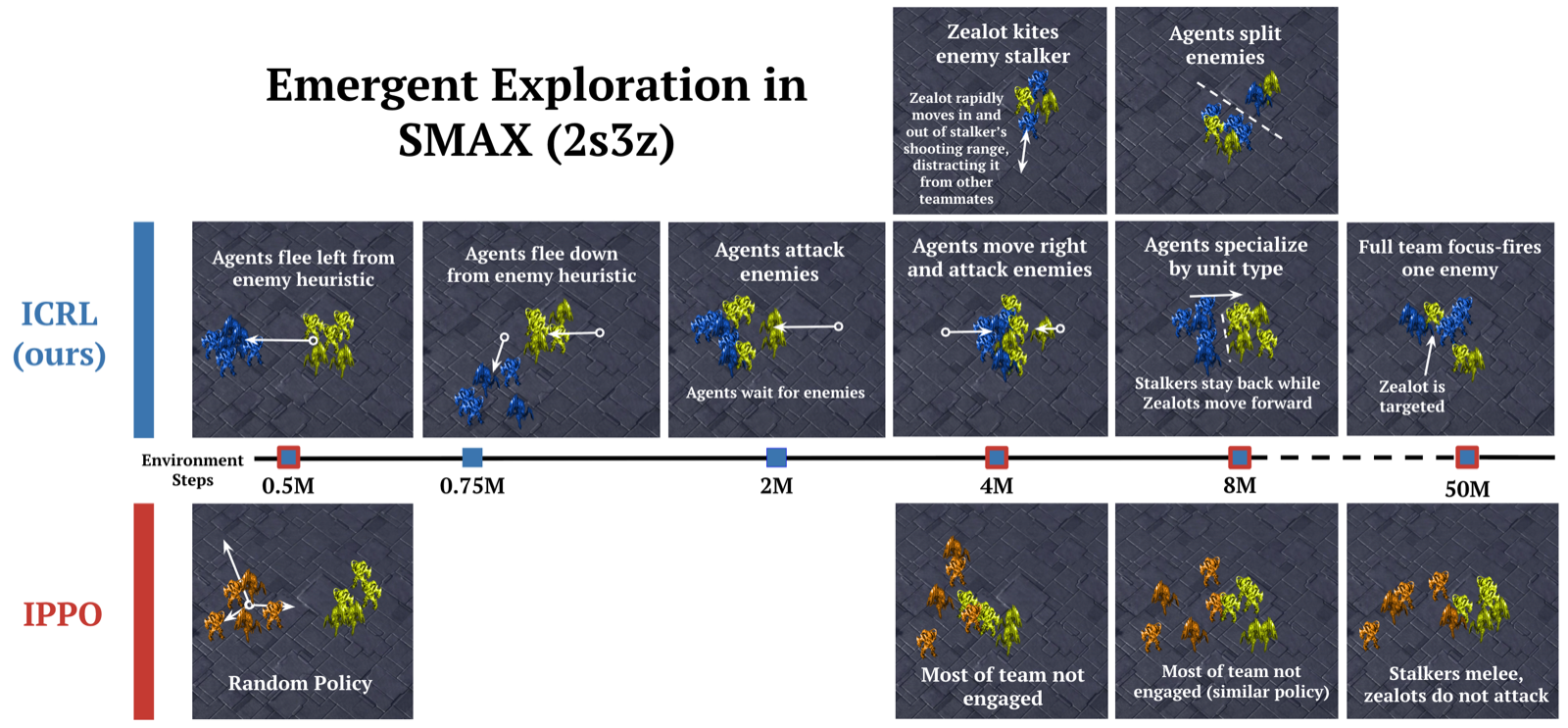
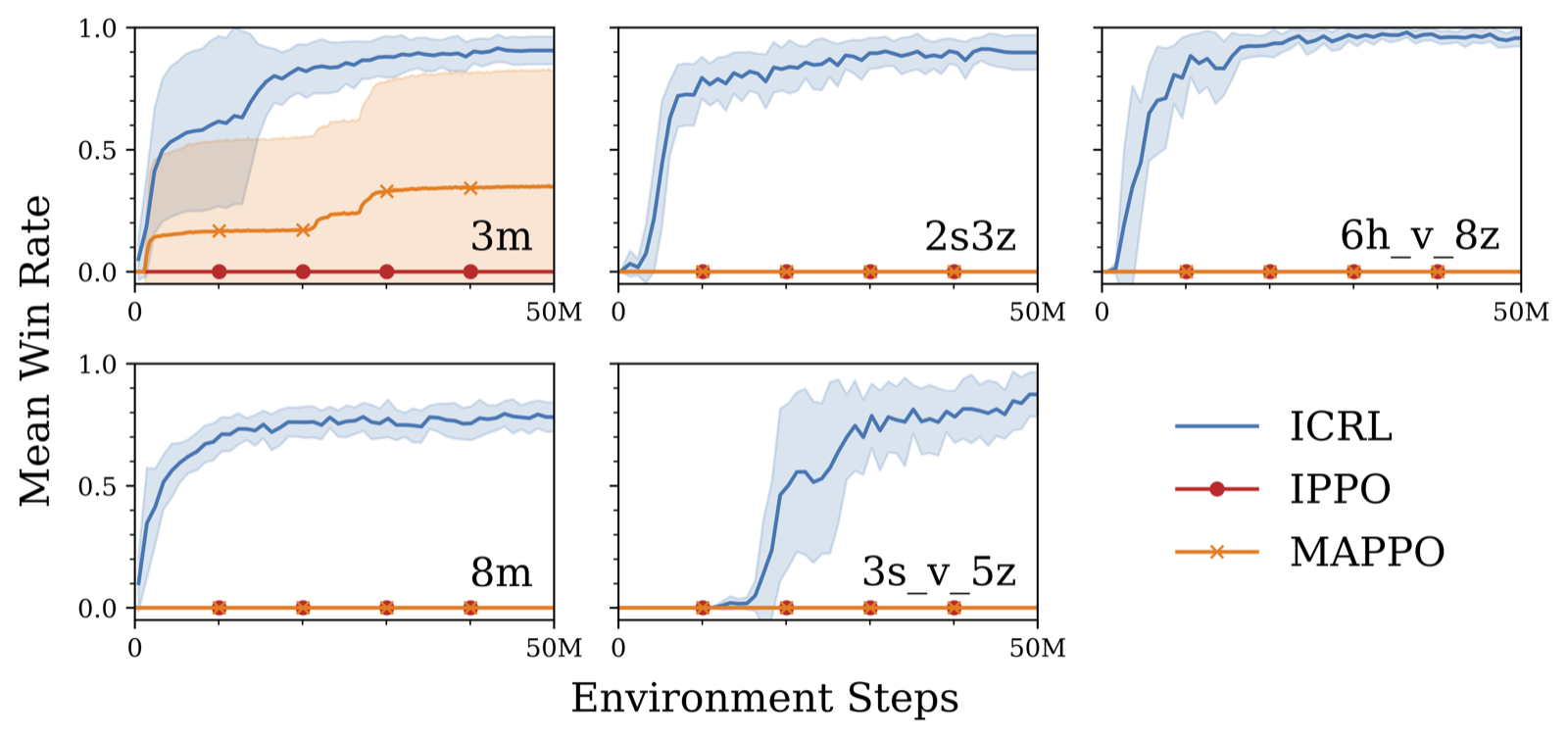
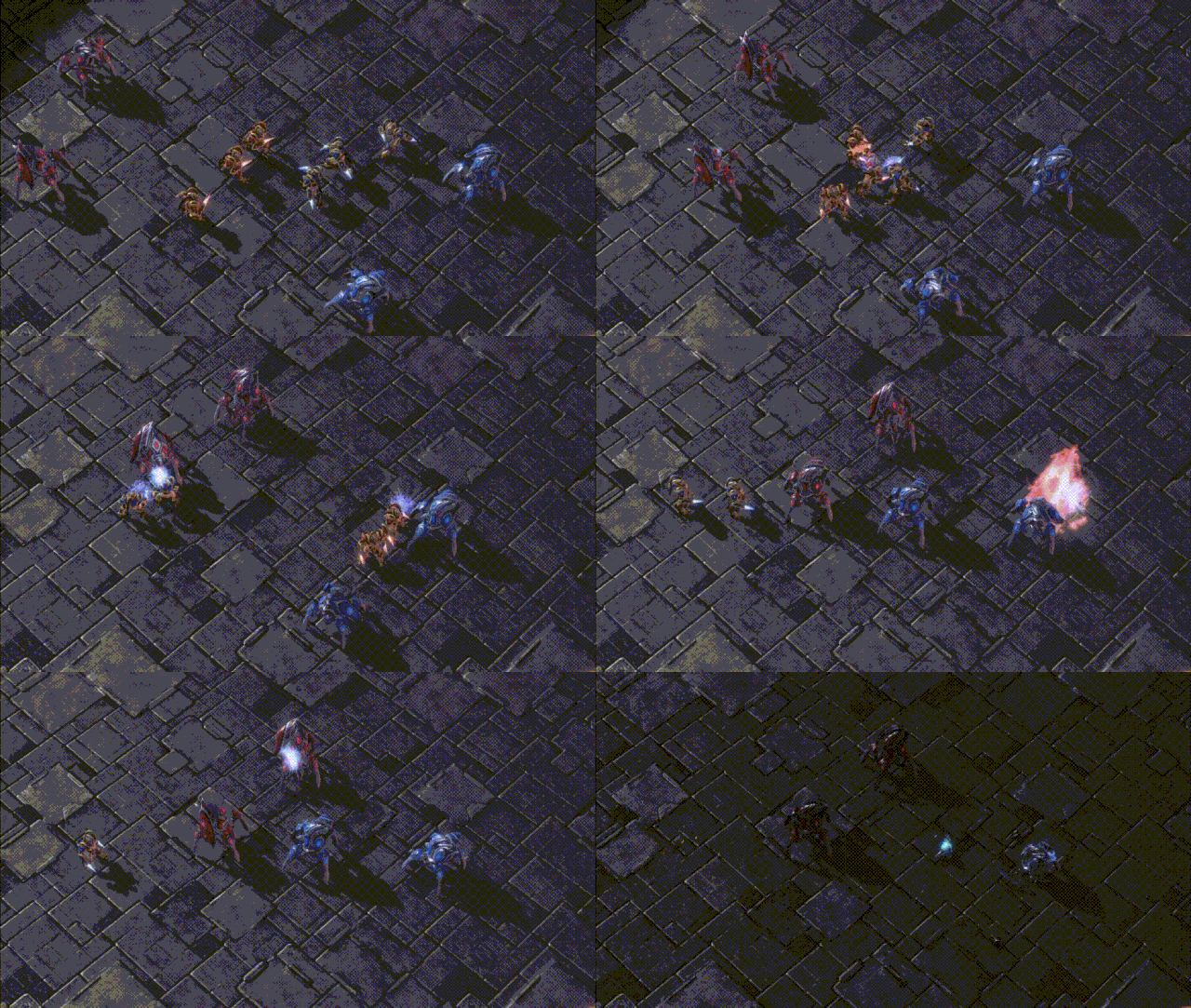
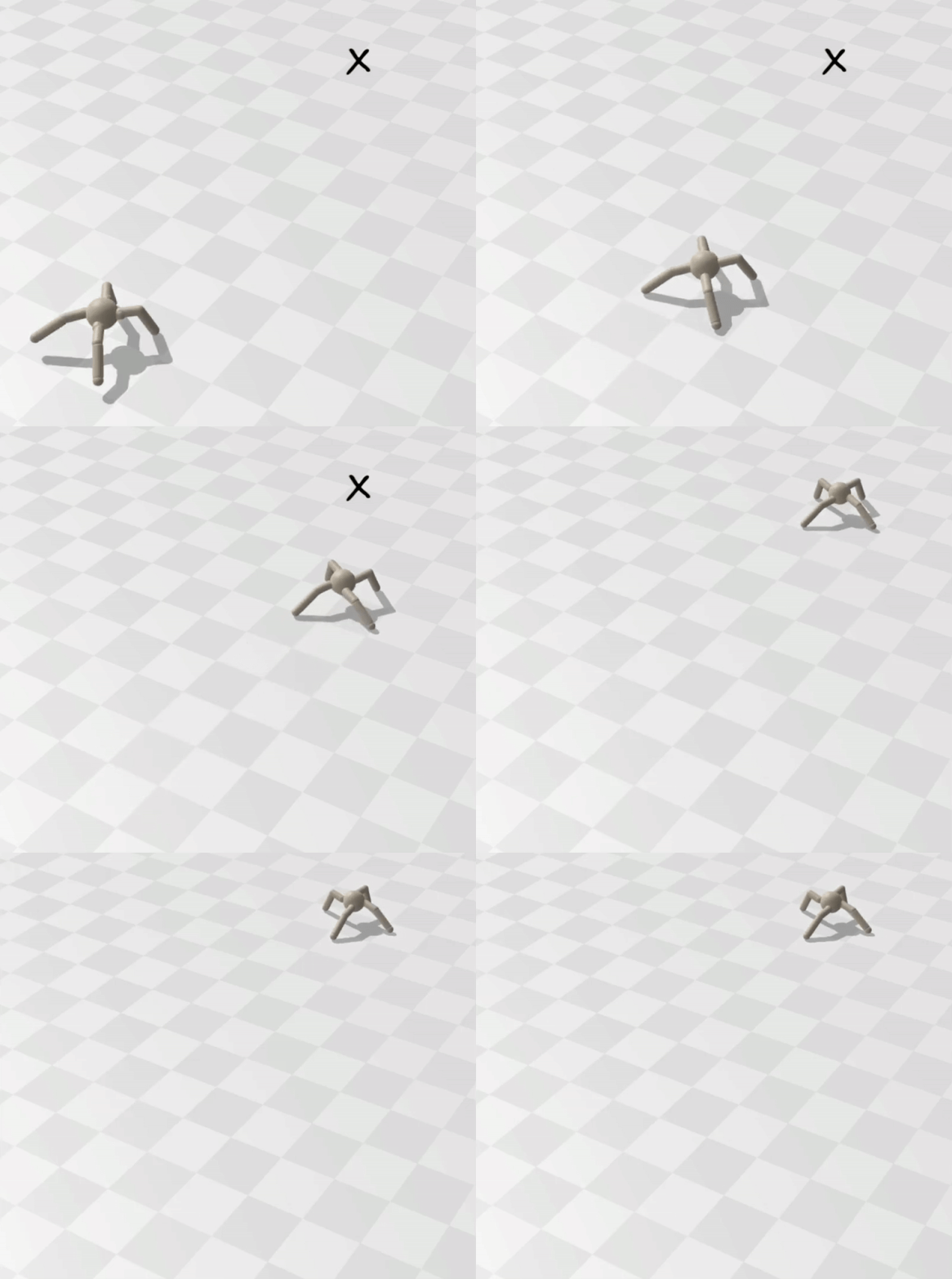
Our solution. We reframe this instead as a goal-reaching problem: we give the agents a shared goal and let them figure out how to cooperate and reach it without any additional guidance. The agents do this by learning to maximize the likelihood of visiting that shared goal. Despite giving very little guidance, we observe that our method performs very well on a variety of tasks, outperforming other methods with access to the same signal — and that agents explore different strategies despite never being explicitly incentivized to.
Abstract
For groups of autonomous agents to achieve a particular goal, they must engage in coordination, long-horizon reasoning, and credit assignment to determine which action by which agents contributed to success. While such tasks are usually viewed as scalar reward maximization problems in a multi-agent RL setting, we reframe this problem as a multi-agent goal-conditioned RL problem where agents cooperate to maximize the likelihood of visiting a certain goal. This problem setting enables human users to specify tasks via a single goal state, rather than implementing a complex reward function. While the feedback signal is quite sparse, we will demonstrate how reframing this as a goal-conditioned problem allows us to leverage self-supervised goal-reaching techniques to learn such problems. On MARL benchmarks, our proposed method outperforms alternative approaches that have access to the same sparse reward signal as our method. Intriguingly, while our method has no explicit mechanism for exploration, our empirical results demonstrate the same "emergent exploration" phenomenon observed in self-supervised goal-reaching algorithms in the single-agent setting, including in settings where alternative approaches never witness a successful trial.
Results
Examples of Learned Policies
Citation
@misc{gcmarl2025selfsupervisedgoalreachingmultiagent,
      title={Self-Supervised Goal-Reaching Results in Multi-Agent Cooperation and Exploration},
      author={Chirayu Nimonkar and Shlok Shah and Catherine Ji and Benjamin Eysenbach},
      year={2025},
      eprint={2509.10656},
      archivePrefix={arXiv},
      primaryClass={cs.LG},
      url={https://arxiv.org/abs/2509.10656},
}